All States
Kundan Jewellery
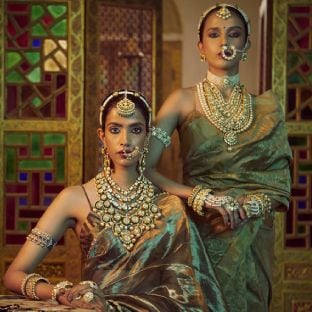
Deep-rooted in the royal era of India, Kundan jewellery, also known as Kundan Keshri, Bikaneri or Jaipuri jewellery, has become an essential part of the traditional bridal wedding trousseau and heirloom collections. The term kundan, meaning highly refined pure gold, refers to the pure molten gold foil used as a mount for the gems. This hand-crafted signature style is meticulous and time-consuming. It uses the traditional Kundan jewellery making process, where gemstones are fixed without using prongs or claws. For centuries, highly skilled Kundansaz have adopted this unique gemstone setting style that involves carefully placing and pressing polished precious/semi-precious stones in individual cavities lined with a gold foil. Mostly, this type of jewellery also has a wax core.
The origins and history of Kundan jewellery in India can be traced to the 3rd century BCE. The art discovered in Rajasthan flourished under the patronage of the Mughals. Over the years, the popularity grew beyond the royal robe. Today, craftsmen from Rajasthan, Bihar and Punjab are recreating Kundan jewellery in gold and silver, using the traditional thappa and ras rawa techniques.
While originally, Kundan jewellery had uncut diamonds; sometimes, glass is used to cut costs.
Kundan jewellery also has some common motifs. Floral patterns that represent beauty, nature, and fertility are a favourite. Different kinds of flowers, such as lotus, rose, jasmine, and tulip, are often found on different types of Kundan Jewellery such as Kundan necklaces, bangles, earrings, etc. Kundan jewellery pieces also have delicate patterns of leaves and vines, symbolising growth, prosperity, and vitality. There are also birds and animals like peacocks, parrots, and elephants that depict Indian mythology, folklore, and nature. You can even find a pretty paisley or mango pattern that is said to bring good luck and prosperity.
Basically, all these motifs designs drew inspiration from architecture that prevailed in the Mughal era. Mughal-inspired arches, domes, and geometric pattern motifs are also enamelled on Kundan jewellery.
The whole process or art of making kundan jewellery is called jadau. The word Jad means to be embedded. It is the coming together of Kundan (a pure gold jewellery form of setting that encases different types of kundan stones) and Polki (uncut diamonds, emeralds, rubies).
READ MORE →
Polki Jewellery
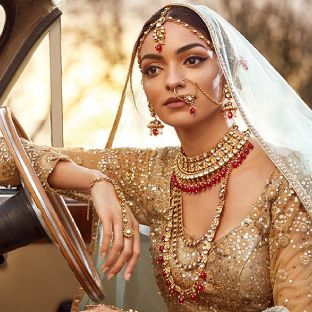
Polki jewellery gets its name from the diamonds used in it. The meaning of Polki jewellery lies in its historical and artisanal significance, as it represents one of the oldest forms of diamonds used in royal jewels. These natural diamonds, in their original raw and rough form, are only carved to follow the stone's original structure. They have an unfaceted polished surface that gives off much softer light compared to the sparkle of modern cuts. Uncut and unpolished diamonds used in their original state without any physical or chemical treatment are called Polkis.
Polki jewellery has uncut diamonds as one of its core elements. It is crafted by placing the uncut Polkis using gold foils or strips and lac. The beauty of Polki jewellery lies in the imperfections of the Polkis. As no two Polkis are identical, each handcrafted jewellery piece looks distinctly unique and one-of-a-kind.
There are three types of Polkis: Syndicate, Zimbabwe, and Kilwas. Syndicate Polkis have the best clarity, followed by Zimbabwean Polkis sourced from Zimbabwe in Africa. Kilwas Polkis are typical of low quality, colour, and clarity.
Polki jewellery’s traditional and intricate designs lend timeless beauty and historical significance. Over the last few decades, several top Indian jewellery designers have created a renewed interest in Polki jewellery by launching their own line of Polki bridal wear. Celebrities have been wearing necklaces, earrings, bangles or bracelets with Polki diamonds and exquisite enamel work to red-carpet events and occasions. Today, Bikaner in Rajasthan remains the most revered hub for Polki jewellery. Jaipur and Hyderabad are also renowned for producing fine Polki pieces. Even Orissa, Uttar Pradesh, and Gujarat produce Polki jewellery. Though most factors remain the same, there may be some variation in design from one place to another depending on local preferences, innovations and techniques.
READ MORE →
Temple Jewellery
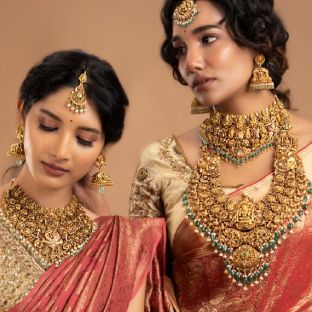
India is the land of temples. Temples have nurtured faith, glorified architecture, unravelled scientific knowledge, inspired artisans and become a part of India’s rich cultural heritage. Temple jewellery has its origin and draws inspiration from these ancient temples. The temple jewellery meaning lies in its ability to connect tradition with craftsmanship, from motifs of peacocks and lotus to depictions of Gods and Goddesses, every piece of temple jewellery holds cultural and religious significance.
Handcrafted in pure gold and embellished with gemstones like diamonds, rubies, emeralds and pearls, temple jewellery of the 21st century is crafted with a traditional look and contemporary feel. Chunky 22-karat necklaces, thick bangles, dangling earrings, customary kamarbands, tinkling anklets, and forehead maang tikkas represent the various types of temple jewellery and brought to life using filigree work, granulation, and embossing. From daily wear and bridal trousseau to heirloom pieces, temple jewellery is a favourite acquisition for many families in southern India. You can also find temple jewellery in silver or metal with gold polish.
READ MORE →
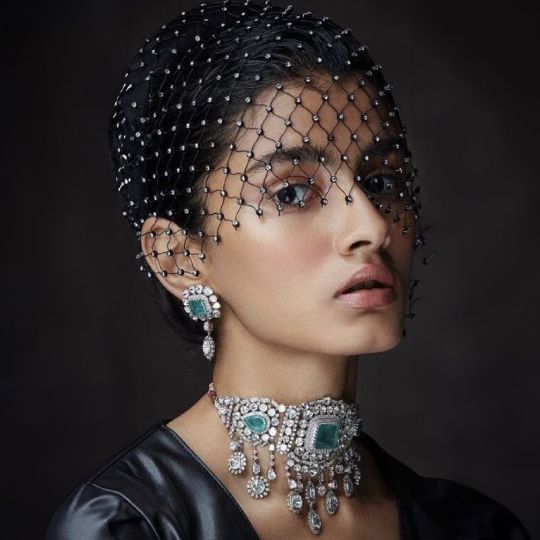
Zircon Jewellery
For decades, colourless Zircons called Matara or Matura diamonds have been a favourite substitute for natural diamonds. Set in jewellery, these Zircons are known for their brilliance, dispersion, and fire. Zircon jewellery meaning lies in its versatility, with Both colourless Zircons and coloured Zircons in hues of blue, green, yellow, orange, brown, red, and reddish brown have decorated necklaces, earrings, bangles, and bracelets. Natural high Zircons, unaffected by radioactivity, are sometimes heated at 800 to 1000 degrees centigrade to enrich or transform their colour, increase transparency, and imitate the optic properties of diamonds. Mostly brown Zircons, when heated, transform into colourless or blue Zircons. These colourless Zircons are called Sparklites or Matara Diamonds, and the blue Zircons are called Starlites or Stremlites. The other trade names given to Zircons are Jacinth for yellow to orange, Hyacinth for red to reddish-brown, Ligure for green, and Cinnamon for brown. Today, the most beautiful Zircons are mined in Australia, Cambodia, Madagascar, Canada, Ukraine, Myanmar, Sri Lanka, and Thailand, with Australia producing 37% of the world's total Zircons supply.
Zircon is a naturally occurring mineral of the nesosilicate group, dating back 4.4 billion years. For centuries, it has captivated jewellery enthusiasts. Most European and American jewellers use colourless, white, blue, and golden-yellow zircons to maximise their optical effects. The colourless, clear, and white variation of the Zircon that closely resembles the diamond has served as an affordable option for diamond jewellery. Besides being considered an ideal natural substitute for diamonds, Zircons, with their wide range of colours, lustre, and durability, have been treasured since ancient times. This semi-precious gemstone is sometimes even mistaken for Cubic Zirconia, a synthetic stone.
READ MORE →
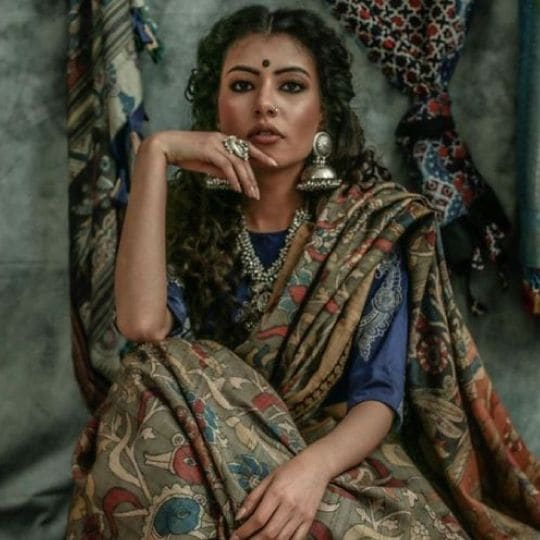
Oxidised Jewellery
Oxidised jewellery has played a fascinating role in the history and heritage of various regions. Oxidised jewellery meaning refers to jewellery crafted using a deliberate process that darkens silver or other metals, creating a tarnished or antique finish. While silver jewellery is admired for its sparkly beauty, its oxidised version has created a unique dimension by fusing science with artistry. Primarily, oxidised jewellery was silver jewellery deliberately darkened to create a tarnish or patina. Though silver jewellery does tarnish when exposed to chemicals, perfumes, salt water, and humid conditions, it is oxidised artificially for aesthetic appeal. Oxidisation also protects the ornament from corrosion and gives it an antique finish.
In the fashion industry, this type of jewellery is known by several names, such as blackened sterling silver jewellery, bohemian jewellery, ethnic tribal jewellery and vintage or antique jewellery. From necklaces, earrings, rings and bangles, oxidised jewellery is available in silver and artificial metal. It is used for aesthetic, spiritual and symbolic purposes, as a sign of status, to express love and loyalty, and to protect the wearer from evil spirits.
READ MORE →
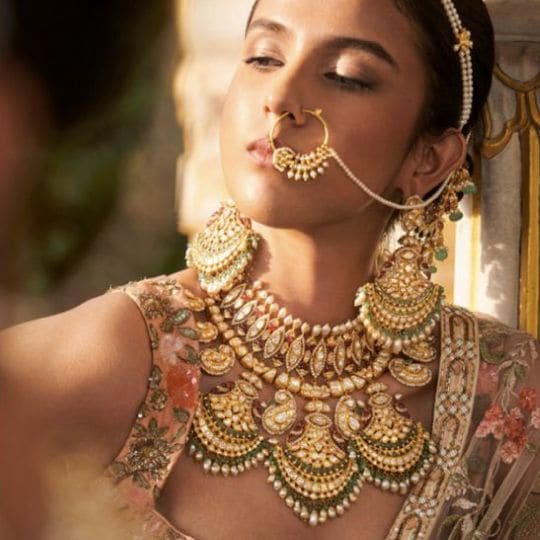
Silver Jewellery
Spanning centuries and cultures, the meaning of silver jewellery lies in its ability to signify beauty, durability, and versatility, making it a noble metal and one of the oldest and most important metals used by mankind. Though traditionally classic gold and platinum remain a strong contender, the history of silver jewellery reveals its presence everywhere, from fashion ramps to Gen Z jewellery boxes. Also, silver jewellery has bejewelled everyone from the most beautiful women to idols of Gods and Goddesses.
READ MORE →
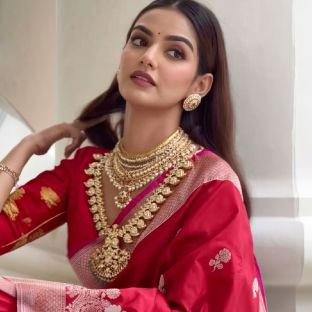
Meenakari Jewellery
Meenakari, or Minakari, is a form of enamelling metals and tiles. The ancient art can be traced back to the Parthian and Sassanid empires of Persian history that ruled from 247BCE to 651CE before being overthrown by the Arab Rashidun Caliphate. Formed from two original Persian words –. M?n? or Meena meaning paradise, and k?r? meaning work on an object; M?n?k?r? or Meenakari means placing paradise on an object.
Found in jewellery, utensils, and decorative metal objects, the beautiful art of etching and colouring with enamel involves intricate geometric designs in vivid hues. The history of Meenakari dates back to the 16th century when this original art form found its way to India and later spread to Pakistan, Afghanistan, China, Greece and Russia. The Moghul emperor Akbar first introduced Meenakari work in India. The artisans decorated thrones, ceilings and walls in the royal palace. Soon, Raja Man Singh of Amber brought the craft to Jaipur, Rajasthan, where artisans improved and excelled in Meenakari jewellery making. From the 16th through the 19th century, the art form gathered recognition as Mughal and Rajputana royalty began to purchase and wear Meenakari jewellery. The intricate designs showcased flowers, leaves, elephants, peacocks, parrots and paisley patterns set with precious and semi-precious stones, including pearls, diamonds, rubies, and emeralds.
Today, different styles of meenakari jewellery, such as Khula Meena, Band Meena, Panchranga Meena, Gulabi or Banarasi Meena, represent regional diversification of the art. Meenakari jewellery manufacturers and exporters have established a thriving business employing thousands of highly skilled kaarigars in Rajasthan, Gujarat, West Bengal and Uttar Pradesh.
READ MORE →